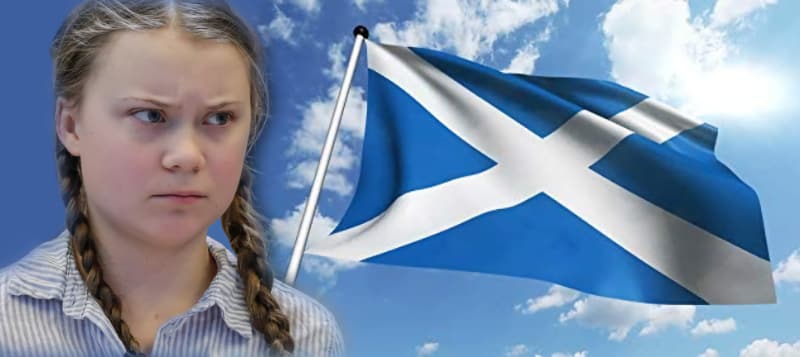
A BBC Scotland interview with the climate change activist Greta Thunberg propelled Scotland’s online Nationalist community into a state of apoplexy in the final week of August. It was portrayed as another ‘manufactured story’ by the BBC designed to paint Scotland, the Scottish Government (and, by implication, the cause of Scottish independence) in a bad light. After the dust had settled, we decided to examine their case.
Two months ahead of Glasgow hosting the COP26 international climate conference, BBC Scotland’s environment correspondent, Kevin Keane, thought he had got a decent line out of Greta Thunberg. Asked whether she thought Scotland was a ‘world-leader’ in tackling climate change, she had replied “no”.
At the crack of dawn, and within a mere hour of the story being published, the social media account @msm_monitor leapt into action like a missile approach warning system, ready to defend the good name of the Scottish Government against any perceived attack whatsoever. This was but the first of 24 anti-BBC tweets issued that day:
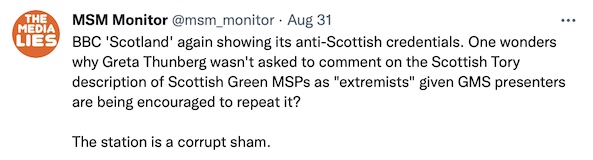
No justification is offered as to why the BBC is ‘anti-Scottish’ or ‘a corrupt sham’ in relation to this story. The resort to ‘whataboutery’ simply betrays @msm_monitor’s lack of arguments or evidence.1 As far as he is concerned, any ‘negative’ story about the Scottish Government must be a result of media bias. You can argue just how ridiculous a notion that is, but what is undeniably true is that it is a prejudice: that is, a judgement formed without due consideration of the relevant facts. It could scarcely be otherwise at 6.58am when the story had only just been published. But when you’re running a social media propaganda machine it’s important to get the assertion out there as quickly as possible: to fire-up like-minded followers and frame the narrative before most people have had a chance to judge the story for themselves. It is, in short, an attempt to neutralise a ‘negative’ story.
Once the flag of ‘media bias’ has been raised, an army of online Nationalists are motivated to scrape together ‘evidence’ which, they hope, might convince a wider public. But rather than presenting evidence which leads to a conclusion, they are starting with a conclusion and working backwards. The inevitable flaw in this approach — known as ‘confirmation bias’ — is that you actively select or reinterpret evidence that will support that conclusion. After all, having so confidently proclaimed that the BBC is guilty of bias, you would look pretty stupid if you were to subsequently concede that, based on the evidence, you were, in fact, wrong! Clinging to a prejudiced position, no matter the facts, leads critics of the media into all sorts of logical contortions and knots, as we shall discover.
Nonetheless, they did not have to look too hard before they discovered that the BBC had handed them a gift with its online headline:
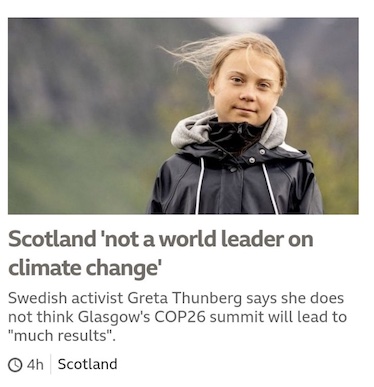
This may have been a fair summary of Thunberg’s comments, but whoever wrote the headline had mistakenly believed the words to be a direct quote from Thunberg and inserted quotation marks where they did not belong. This was a clumsy error compounded by the fact that it took up to six hours for the BBC to correct. This blog will never shirk from calling out the media where it makes mistakes, but cock-ups are not conspiracies, despite the attempts of critics to conflate the two. Take, for example, this tweet from the SNP MSP James Dornan:
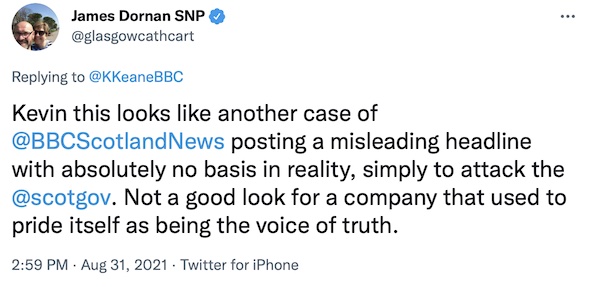
Mr Dornan was right to complain, but when he goes on to suggest that the headline has “absolutely no basis in reality” he overstates his case. The headline was misleading insofar as it erroneously suggested a verbatim account of Thunberg’s actual words. It did not, however, misrepresent her views about Scotland’s record on climate change. What is more disturbing, however, is Dornan’s assertion that the headline had been constructed “simply to attack the Scottish Government”, echoing very much the view of @msm_monitor, an account whose posts Mr Dornan has been known to retweet and correspond with approvingly. It is one thing for an anonymous social media account to charge the media with conspiracy, it is quite another when an elected politician repeats those claims.
‘She didn’t mention Scotland at all’
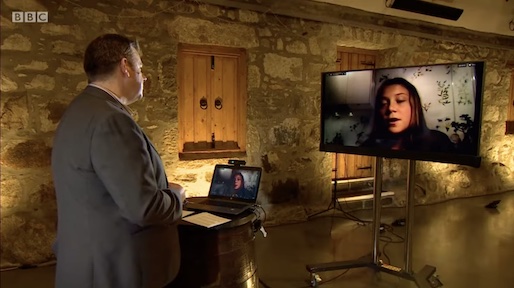
Those who watched the video footage of the interview, either online or on television, had the benefit of hearing the actual exchange, which was as follows:
Keane: Do you see Scotland as a world leader?
Thunberg: No, I mean, I don’t… of course there are countries who do a bit more than certain others, but then again if we look at it in a broader perspective, I think that we can safely say that there are no countries, at least in the global north, that are doing even close to what would be needed.
But Richard Walker, the founding editor of the avowedly pro-independence newspaper, The National, was not convinced that Thunberg was doubting Scotland’s ‘world leader’ credentials. The reason?
Thunberg didn’t mention Scotland at all.
This is peculiar logic. Scotland was the subject of the question — to which she gave a direct answer. And yet, Walker continued:
But she does admit that some countries do more than others, and to me there’s a clear inference that Scotland is one of those countries, since Scotland was the subject of the question.
Hold on. So when Thunberg says something negative it should be dismissed on the basis that she never uttered the word ‘Scotland’ — yet, when she says something positive, the high qualification bar is mysteriously dropped and we are all now blessed with the power to infer she absolutely did mean Scotland after all. And Walker has the cheek to accuse the BBC of ‘twisting’ words!
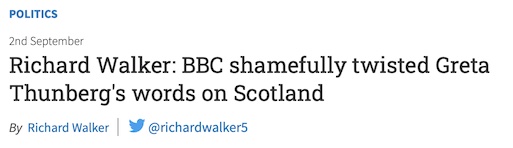
But there’s more. Both Walker and @msm_monitor want to convince us that when Thunberg said “no” she didn’t really mean no. It was all, well, a bit more complicated than that:
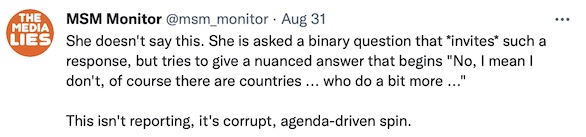
It’s odd to charge a journalist with asking a direct question — heaven forfend! — but to suggest it invited only a negative response is patent nonsense. Thunberg could have answered in any number of ways, with options including “yes”, “maybe” or “I can’t really answer that question”. It is certainly the case that Thunberg goes on to contextualise her answer, but far from ‘nuancing’ her belief that Scotland is not a world leader, her clarification underlines it to the extent we are left in no doubt at all. If no country in the ‘global north’ is a world leader, logic dictates that Scotland is no exception.2
Why single out Scotland?
It can scarcely be in any doubt that Thunberg does not believe Scotland to be a world leader but, as one Twitter user asked, why did the BBC “single out Scotland” when, after all, she said that no country is a leader and some are better than others? It’s a fair question.

Others made the related point that Thunberg had clearly not gone into the interview intending to focus on Scotland, let alone criticise it. Doubtless true. But it is the interviewer that gets to set the questions, not the interviewee, and it is perfectly reasonable that a Scotland-based journalist, broadcasting to a Scottish audience, on a programme about Scottish affairs, might want to focus some of his questions on Scottish aspects of a story, not least when that very same country is playing host to an international climate change conference.
Having dissected every word of Thunberg’s response and subjected it to painstaking analysis, focus now turned to the question. “Do you see Scotland as a world leader?” was thought by @msm_monitor to be an “odd question”, while Scott McCafferty suggested it was just plain “dumb”:

The implication is that Keane had concocted this notion of Scotland being a ‘world leader’ out of thin air, setting an unrealistically high bar which Thunberg could do no other than rubbish. In other words, a trick question designed to garner an anti-Scottish Government headline. Of course Scotland isn’t a world leader. I mean, who would suggest such a thing?
”Scotland is already leading the world on climate change” — Nicola Sturgeon, BBC Leaders Debate, 30 March 20213
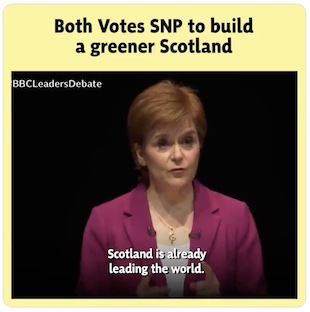
Either online Nationalists have very selective memories, or, like Scott, they’ve never really taken the Scottish Government’s claims seriously. One wonders if it is only “dumb” when the BBC refers to Scotland’s world-leading claims, or whether they believe that applies to the First Minister too?4
In a democracy it is the job of journalists to subject the claims of politicians and governments to scrutiny. So when Keane has the rare opportunity to interview the most famous climate activist on the planet — someone well-placed to compare the progress of different countries — it would, arguably, be remiss of him not to ask what she thought of Scotland’s ‘world-leading’ credentials.
They edited it!
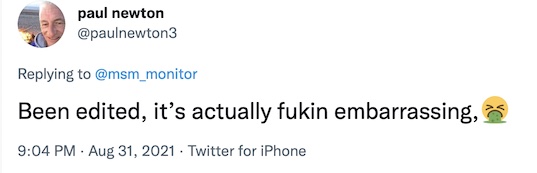
Conspiracy theorists often charge the media with the crime of ‘editing’, unable to grasp the fact that it is an essential part of the storytelling process, for time considerations let alone anything else. Upon seeing Keane’s full report on television, @msm_monitor was in full conspiratorial mode:
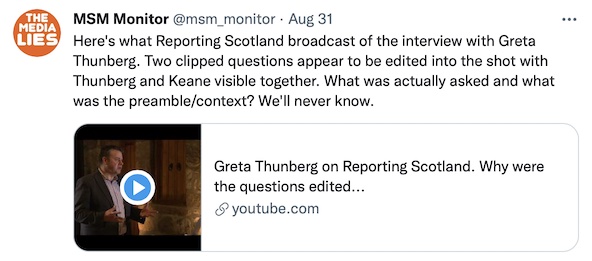
“We’ll never know,” he says with certainty, adding to the innuendo that the dastardly mainstream media has something shameful to hide. Never? How about the very next morning? In what was doubtless an attempt to prove it had nothing to hide, the BBC provided the full unedited interview, both as a written transcript and as a full audio recording in a podcast. And Keane’s rather long question, which had indeed been edited5, was very revealing indeed…
Keane: Now, you recently criticised the UK government for its creative accounting. The Scottish government does include international shipping and aviation in its accounting and it’s one of the few countries of the world, perhaps the only that does that. What do you see as the position Scotland has? Do you see Scotland as a world leader?
The context here is a series of comments Thunberg made two weeks earlier when she said that it was a “lie” that the UK was a ‘world-leader’, adding that it was “very good at creative carbon accounting”. Keane is putting to her how much better Scotland is in that regard — indeed, he even highlights how it might be the only one in the world to take the steps that it has — and invites her to give her view. You might even say he is inviting her to agree! Does this sound to you like a journalist with an agenda against the Scottish Government? You’ll recall our observation that Nationalist critics actively select evidence that supports their prejudice that the media is biased against them. You won’t be surprised to learn that this piece of (inconvenient) evidence was completely glossed over.
Greta’s silence
If Greta Thunberg had been so outrageously misrepresented by the BBC, one might have thought that she would have more reason to feel aggrieved than any number of angry Nationalists? It’s a thought that occurred to many who gallantly informed her of the BBC’s supposed crimes and implored her to respond (for her own good you understand):


Despite the pressure brought to bear on Ms Thunberg, she made no complaint.
The boot test
In the final analysis, one of the most effective (and revealing) methods of judging complaints of media bias is to apply the ’what if the boot was on the other foot?’ test. In other words, what if the situation was reversed? In this case, what if Greta Thunberg had been asked, “Do you see Scotland as a world leader?” and she had replied, “Yes, I mean, I do…,” and on that basis the BBC had headlined: “Great Thunberg: Scotland is a world leader on climate change”?
Would online Nationalists have thought the question quite so “dumb” then? Would it have mattered that she hadn’t said the word “Scotland”? Would they be quibbling about the nuance in her reply? Would the BBC have been accused of sneaky editing? And would Nationalists be imploring Thunberg to complain out of concern that she might have been mis-represented?
—
- And what a desperate example of ‘whataboutery’ it was. We’re being led to believe that petty name-calling between two opposition parties in the Scottish Parliament — an obsession that appears to have concerned no-one outside the Nationalist Twittersphere — should be one of the main questions put to an international climate change activist. More important, that is, than holding a government to account for their record on tackling the single biggest issue facing the world today. If ever there was an example of the parochialism of social media bubbles, this must surely be it. ↩
- It worth remembering in all of this that not only did the BBC broadcast Thunberg’s ‘contextualisation’, it highlighted it in the introduction to the story. The top line — that Thunberg did not believe Scotland to be a world leader — was immediately qualified in the very next line — that she recognised some countries “do a bit more than others” but that none were coming close to what was needed. The public were therefore furnished with all the relevant facts to make up their own minds. ↩
- The First Minister and her Scottish Government have claimed to be ‘world leaders’ on multiple occasions. As well as proudly tweeting a clip of Ms Sturgeon’s boast in the TV debate, a Scottish Government press release a year earlier stated that “Scotland has set world-leading targets to become a net-zero emission country by 2045”. ↩
- Richard Walker in The National certainly doesn’t believe the claim to be “dumb”. He wrote that “the description of world leading could accurately be attached to Scotland”, yet in another example of twisted logic he was “surprised that Thunberg even knew enough about Scotland’s contribution to pass judgment”. Surely if any country was a ‘world leader’ — that is, the very best in the world — then, regardless of its size, you might have thought such an impressive accolade might have attracted the attention of one of the world’s most prominent climate change campaigners? ↩
- Why was the question edited? As anyone who knows how television news works, editing is a necessary part of the job. Keane’s full question was rather long, taking 20 seconds to ask. And that’s before you even include Thunberg’s answer, which is about another 40 seconds. That would account for up to a third or a half the duration of a typical TV news report — and that’s before you include all the explanatory material and other lines you may want to include. ↩
 Chamber of Echos
Leave a comment