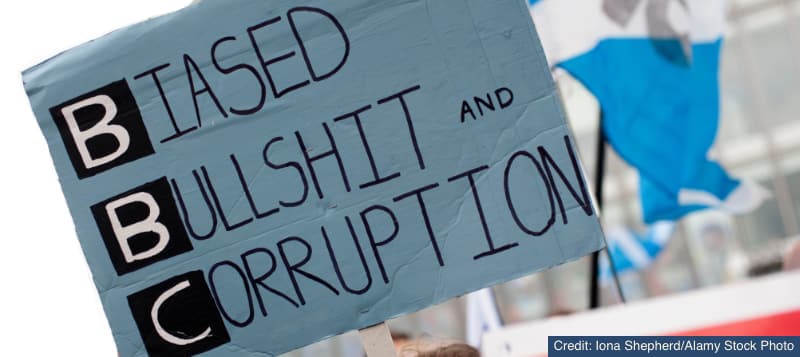
Impartial journalism is under relentless attack. From ordinary citizens to political leaders and US Presidents, it has become fashionable to denounce the so-called ‘mainstream media’ and its supposed ‘bias’. Those who do so are not impartial analysts of the media; they are invariably highly-partisan campaigners associated with a particular political cause. This makes them especially susceptible to ‘confirmation bias’: the tendency to search for, interpret, favour, and recall information in a way that confirms or supports their prior beliefs or values. If you’ve already made your mind up about an issue — in this case, that the media is biased — it is surprisingly easy to construct a persuasive argument by selectively citing facts or placing a particular spin on the truth.
Social media algorithms reinforce these biases by an order of magnitude, creating ideological echo chambers in which like-minded people agree with each other and differing viewpoints are rarely heard. Like a hurricane gathering strength as it moves, these feedback loops become so powerful that an almost cult-like mentality takes over, leading followers down the rabbit hole of ever more entrenched or, at times, extreme positions. So when impartial journalism enters the frame, reporting inconvenient facts and arguments that do not conform to the ideology, the simplest solution is to undermine the credibility of the media. Before the age of social media we lived in a society that managed to deal with opposing opinions respectfully, but we now view people who do not agree with us as bad faith actors or enemies.
It is this phenomenon that has inspired our name, ‘Chamber of Echos’, and it is the aim of our blog to scrutinise the arguments of those critics who allege ‘media bias’.
Lessons from Scotland
Here in Scotland, where this blog is published and from where we will take most of our examples, accusations of media bias have largely, though not exclusively, come from supporters of Scottish independence. The war of attrition began gradually in the wake of the 2007 Scottish Parliament election when the Scottish National Party (SNP) became the governing party for the first time, albeit as a minority. Unaccustomed to the intense scrutiny all governments receive from the media, supporters misconstrued journalism’s long-established role in holding truth to power as an attack on their movement. That sentiment deepened following the 2011 election in which the SNP achieved a majority of seats in parliament, thus paving the way for a referendum on Scottish independence. The long campaign leading up to polling day in September 2014 saw traditional media outlets under attack like never before, just at the point when social media services such as Twitter and Facebook were entering the mainstream and reaching critical mass.
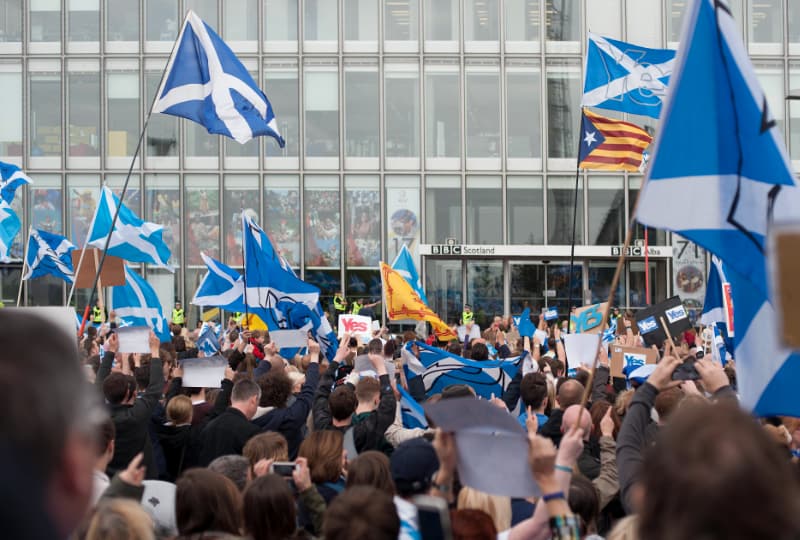
The ‘Yes’ movement’s antipathy towards the media was stoked-up during the campaign by the publication of an academic study which claimed Scottish news broadcasts leaned more favourably towards the ‘No’ side. Its author was Professor John Robertson, a media academic at the University of the West of Scotland, who subsequently left his job to become an active campaigner for the ‘Yes’ movement and a partisan commentator on the BBC’s alleged biases. Weeks after the publication of his report, hundreds of protestors gathered outside the BBC’s Scottish headquarters calling on the Corporation’s political editor, Nick Robinson, to resign after allegations that he had ‘lied’ in a television report.
When the ‘Yes’ movement subsequently lost the referendum, many pointed the finger of blame at the ‘mainstream media’. Within weeks, an avowedly pro-independence newspaper, The National, was launched at an SNP political rally in an effort to redress the balance of the Scottish press, but a lingering resentment against the BBC saw, if anything, an increase in attacks on public service broadcasting. Since 2016, the Twitter account @msm_monitor has operated as a propaganda machine, churning out a daily stream of anti-BBC messages in a clear attempt to discredit the organisation and neutralise all ‘negative’ stories about the Scottish Government or independence.
It is easy to overestimate the readership of such accounts. At the time of writing they attract little more than 20,000 followers each, which is less than half of one percent of the Scottish population, but they do have a wider influence on the independence movement, influencing the opinions of elected politicians and commentators. Indeed, attacking the BBC has become something of a cottage industry. The National, for example, has cynically monetised the ‘click bait’ potential of producing a regular stream of stories attacking the BBC.
All of the above is beginning to have a corrosive effect, not only on support for impartial journalism and public service broadcasting, but on Scottish politics and public life. If left unchecked, the effects on liberal democracy could be profound. We only have to look to the 2021 attack on the US Capitol by a mob of supporters loyal to President Donald Trump to see where this trend could lead.
Our aims
We have no desire to silence criticism. The problem is that we are hearing only one side of the argument. In Scotland, the main public service broadcasters have largely decided not to defend themselves in public. No media organisation, let alone one which is publicly funded, wants to become embroiled in vexatious debate with its own audience. They doubtless also realise that they simply cannot win against people who are so indoctrinated.
And that is where this blog comes in. Our aim is to scrutinise the arguments of those who claim media bias, exposing the fallacies in their arguments and disproving conspiracy theories. Rather than respond instantly to every social media storm that blows up, we aim to take a more considered and reflective approach, waiting until the dust settles and putting forward a considered argument. Taking the long view also allows us to expose the hypocrisy and double standards that only become apparent over time.
We come at this from a non-political perspective. It is perfectly noble to campaign for causes such as Scottish independence; we simply make the point that it is possible to do so without sacrificing the truth and bringing down the whole edifice of public service broadcasting. We have no agenda other than to promote due impartiality and rational argument.
Journalism is not a perfect art. It is constructed by humans and humans make mistakes on occasion. We wholeheartedly support the idea of media literacy; of teaching people the skills to assess and judge news stories for themselves. The more people know how the media actually works — as opposed to the innuendo that is spread about it on social media — the better for society. We will not hesitate to call out its failings, but the lazy argument that journalism is corrupt or biased must be challenged for the good of democracy.
—
 Chamber of Echos
Leave a comment